
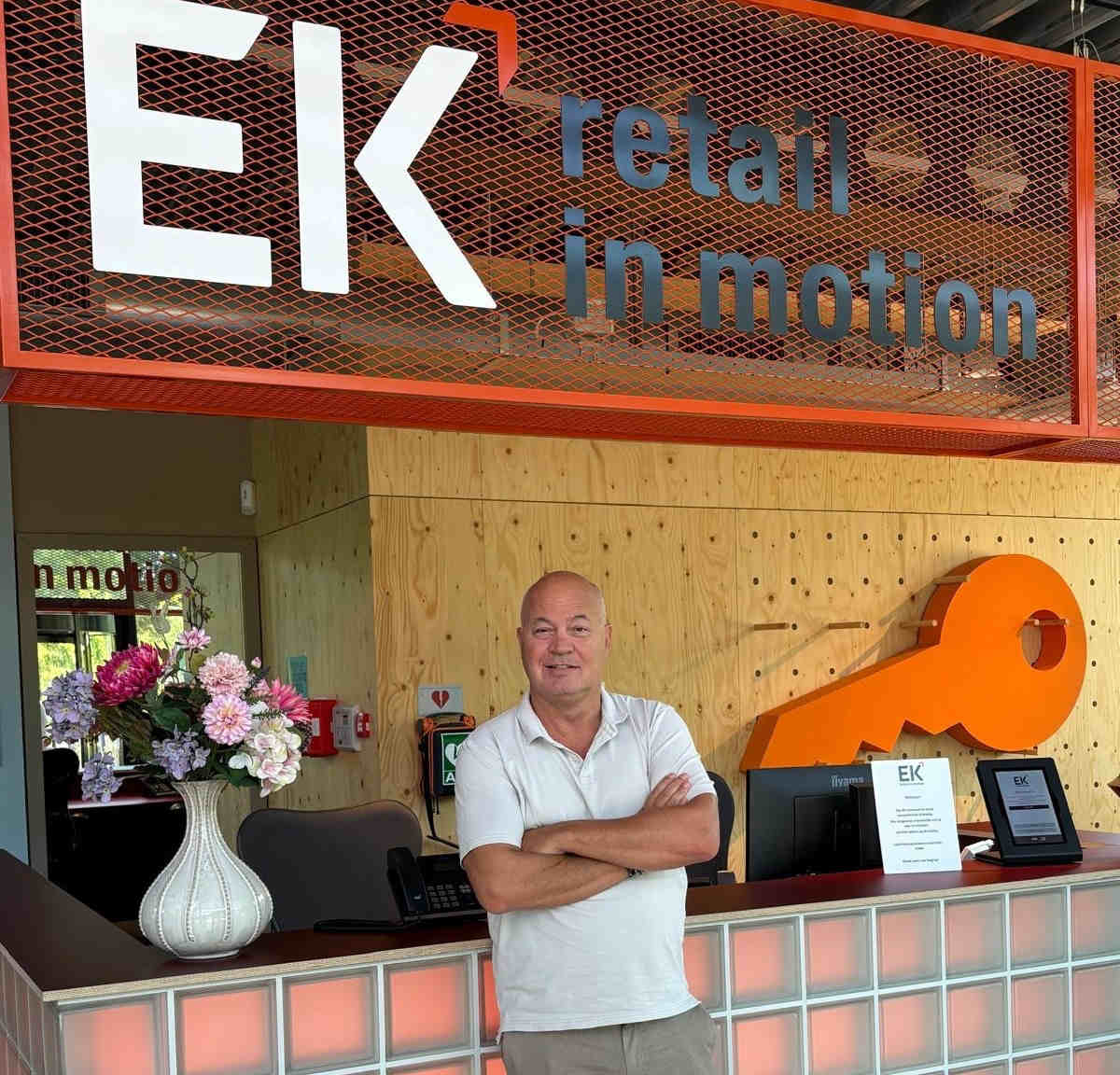
“When I started in the furniture industry thirty years ago, pure commercial spirit was the most important element for success. Today, entrepreneurship in retail has become ten times more difficult. Nowadays, you must not only be a buyer, but also a marketer, social media specialist, and accountant to be able to manage based on key figures and returns, as well as having knowledge of HR to motivate and retain your staff. These are all roles that almost no one naturally combines within themselves. Seeking partners who can provide unburdening is therefore more necessary than ever.”
So says Werner op ‘t Eijnde, who has been in management at EK Retail (formerly Euretco) for sixteen years and is responsible for all affiliated entrepreneurs within the home textiles, furniture, and sleep segments. In a candid conversation, he paints a realistic picture of the challenges on the shop floor: from succession issues to the indispensable flexibility behind the scenes. Behind the scenes, the role of the purchasing organization has changed drastically over the past ten years. “We used to be purely focused on products and private labels. Today, we have transformed into a complete service organization that develops services that the retailer truly needs in practice,” Op ‘t Eijnde begins.
Regional Analysis One of the most frequently used tools deployed by EK Living is the extensive regional analysis. This involves accurately mapping data such as income indices, household compositions, and purchasing power per postcode area. EK Living goes a step deeper with the so-called customer origin analysis.
Werner op ‘t Eijnde: “An entrepreneur often thinks they know exactly where their customers come from. We simply ask them to provide the postcodes and order amounts of their last five hundred orders. When we overlay that data on the market area, it regularly provides enormous eye-openers.”
We recently saw a realistic example in Brabant. An entrepreneur had been directing his marketing for years through a traditional circle of 20 to 25 kilometers around the store. However, the analysis showed that natural and infrastructural barriers—such as highways and rivers—meant that barely 50,000 euros in turnover came from a certain targeted area, even though 200,000 flyers were sent there year after year. At the same time, a wealthy, untapped municipality outside the regular market area turned out to attract many customers due to a natural shopping flow. Such an analysis immediately saves an entrepreneur tens of thousands of flyers, which can be deployed much more effectively based on age, new housing developments, or specific product needs.” Returns under pressure Looking at the market conditions in the interior design industry, it is striking that turnovers generally appear stable. According to Op ‘t Eijnde, however, that is a misleading and even dangerous signal. “Average receipt amounts have risen significantly in recent years due to inflation. At the bottom line, that simply means fewer orders are being written and fewer”
physical customers are coming into the store. When those few customers do enter, conversion is therefore more important than ever. You have to ensure that the customer leaves the store with a satisfied feeling and a signed order.” EK Living therefore organizes ongoing training in the fields of conversion and hospitality, which are consistently fully booked.
The need to manage business operations sharply is high, because returns in retail are unmistakably under pressure. “Turnover remains the same, but costs are rising on all sides. Rents on home furnishing boulevards have risen by as much as 14 percent in two years due to inflation indexation. Add to that the significantly increased personnel and energy costs, and you see returns declining rapidly.”
To provide a mirror for entrepreneurs, the organization uses anonymous financial benchmark reports. “We compare apples to apples. Not a large megastore in Groningen with a local home textile shop, but for example, forty to fifty equivalent home retail businesses with each other. This allows an entrepreneur to see immediately if their key figures, such as margin, personnel, housing, or marketing costs, are out of line. This year, we are seeing the fruits of this for the first time: the return among affiliated entrepreneurs participating in the financial benchmark is starting to rise slightly again.”
Concerns about aging In addition to returns, the increasing aging of the population is currently the greatest structural concern within the purchasing organization. “For years, we have been confronted with entrepreneurs reaching retirement age but having no successor. Children often no longer want to take over the business. They often prefer a 32-hour work week in salaried employment themselves.”
Furthermore, according to Op ‘t Eijnde, the Netherlands suffers from a structural surplus of retail square footage. EK Living acts as an independent matchmaker in this regard. “We sometimes guide entrepreneurs for five years before their planned retirement. We put parties who want to stop in touch with healthy, ambitious entrepreneurs who actually want to expand.”
EK Living Sleep Menu In the sleep segment, EK Living continues to expand significantly. “We recently introduced Topdream, a circular mattress collection under a private label, and the private label Nox (Latin for night)—which was introduced at Euretco at the time and proved to be a great success during the crisis—is now being rolled out in the geographical ‘white spots’ where no Slaapkenner stores are yet located. We will also soon be introducing two new developments in Amersfoort, but more on that later.”
Centralized Payment A significant but often overlooked strategic advantage of the retail organization is the system of centralized payment. The annual independent customer satisfaction survey consistently shows that this service is highly valued by entrepreneurs. “The fact is that centralized payment is almost never the reason a healthy retailer joins us beforehand; they come for the purchasing advantages, the benchmarks, or the private labels. Only once they work with it do they experience its enormous value,” Op ‘t Eijnde explains.
Cultural Change Despite the complex market, Op ‘t Eijnde sees a positive future for ‘local heroes’ with their own identity, provided they organize their back-end operations well and dare to collaborate. “When I started at Euretco sixteen years ago, fear dominated due to the financial crisis and everyone primarily saw each other as competitors; retail consisted of isolated islands. Since the COVID period, however, there has been a clear cultural change underway. Entrepreneurs and even competing purchasing organizations are seeking each other out to openly spar about market developments, labor costs, marketing, and business operations.”
The realization has now widely sunk in: you simply can’t make it on your own anymore in these challenging times. Collaboration at the back-end, while maintaining your own identity at the front-end, offers the solution.”


